
The Ball Method
The Stolen Chemistry, Secret Laboratory Betrayal, and Long-Awaited Justice for Alice Ball

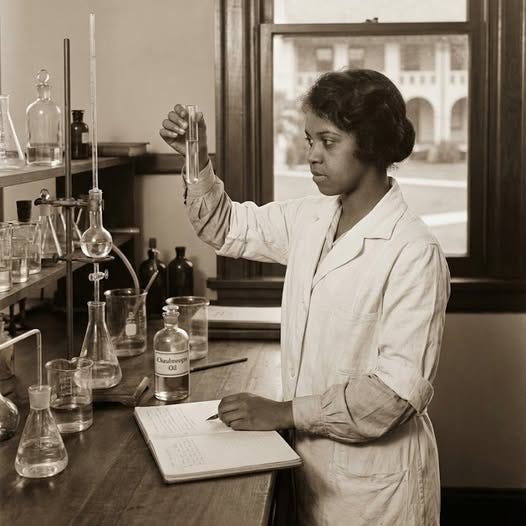
Alice Ball grew up in a house that smelled like chemistry.
Her grandfather, James Presley Ball Sr., was one of the first African Americans to master the daguerreotype — the earliest photographic process, which required coating copper plates with polished silver, exposing them to iodine vapor, and developing the image with mercury fumes. He had photographed Frederick Douglass and Charles Dickens. He had built a gallery in Cincinnati that became famous. He had learned the process in 1845 from a chance meeting with a Black daguerreotypist in Boston and turned it into a life.
By the time Alice was born in Seattle in 1892, the family trade was still photography, and photography was still chemistry. Her mother was a photographer. Her grandfather was a photographer. The darkroom was not a mystery; it was the kitchen. Silver compounds, iodine vapor, mercury — these were the materials of daily life, handled with care and expertise, producing something beautiful from something toxic.
The mechanical reality of a 19th-century photographic studio was effectively a highly hazardous chemistry lab. Silvering the plates required pure copper sheets electroplated with silver and buffed to a mirror finish. The iodine vapor chamber suspended the plate over raw iodine crystals, the vapor reacting with the silver to create a light-sensitive layer — intensely corrosive to the lungs and skin. Mercury fume development required heating liquid mercury to roughly 140 degrees Fahrenheit directly beneath the plate, allowing deadly invisible fumes to coat the surface. The fixative was a bath of potassium cyanide. This was not occasional exposure. This was every day, for a working family making their living from light and chemical reaction.
Growing up with a mother and grandfather who spent their days measuring, mixing, and heating these compounds meant that chemical safety, exact chemical reactions, and the physical weight of laboratory manipulation were Alice’s native language before she ever stepped into a university classroom.
Nobody documented the moment Alice Ball decided to become a chemist. They rarely do, for women. But it is not difficult to trace the line.
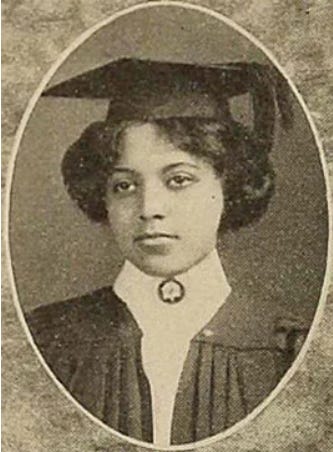
She was sharp from the start. At Seattle High School she excelled in the sciences. After graduating she enrolled at the University of Washington, where she earned not one but two undergraduate degrees — pharmaceutical chemistry in 1912, pharmacy in 1914. While still an undergraduate, she co-authored a paper with her professor William Dehn, published in the Journal of the American Chemical Society. She was not yet a graduate student. She was not yet twenty-two.
In 1914, both the University of California and the University of Hawaii offered her research scholarships. She chose Hawaii and returned alone — a young Black woman traveling across the Pacific to pursue a master’s degree at a time when most institutions would not have admitted her at all.
In June 1915, Alice Ball became the first Black American and the first woman to earn a master’s degree in chemistry from the College of Hawaii. She was twenty-two years old. The university immediately hired her as an instructor in the chemistry department, the first woman to hold that position.
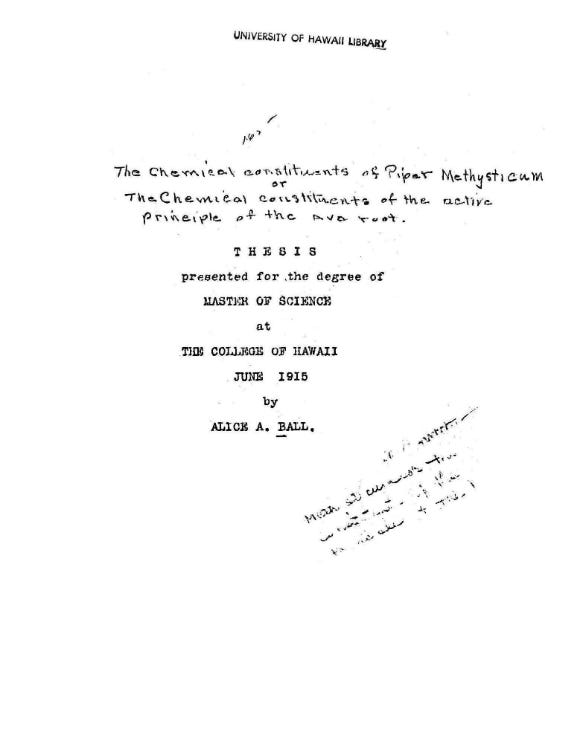
Her thesis was titled The Chemical Constituents of Piper Methysticum, a rigorous chemical analysis of the kava plant, culturally sacred across the Pacific Islands and of significant medical interest to Western physicians who couldn’t figure out how to isolate its active compounds. Researchers had been trying for decades. Ball did it. Forty-four pages. Precise. Methodical. Confident. The committee chair signed off with a single word: Approved.
What the thesis reveals, reading it now, is a scientist who had already found her register. She wasn’t hedging. She wasn’t deferring. She was documenting what she found, naming what she couldn’t yet explain, and drawing conclusions from evidence. She broke through the kava problem by using a sophisticated sequence of solvent extractions and fractional crystallizations — systematically washing the root through varying gradients of petroleum ether, alcohol, and water, manipulating boiling points to strip away inert plant starches while leaving the psychoactive resin intact. The physiological section alone — where she describes injecting kava resin extracts into rabbit ear veins and timing their paralysis and recovery in real time — reads like someone who understood exactly what she was doing and why it mattered.
That thesis landed on the desk of Dr. Harry T. Hollmann, an assistant surgeon at Hawaii’s Leprosy Investigation Station. He had been trying to solve a different problem. He had been trying to solve it for years.
Leprosy, now called Hansen’s disease, had been devastating communities across Hawaii for generations. Under the 1865 Act to Prevent the Spread of Leprosy, the Hawaiian government forcibly removed more than eight thousand people to the remote Kalaupapa settlement on the island of Molokaʻi. They were legally pronounced dead upon arrival. If they had children during their confinement, the children were taken and put up for adoption, their origins concealed. Leprosy didn’t just take your body. It took your family, your name, your place in the world.
Chaulmoogra oil had been the best available treatment for leprosy for over two thousand years. The Sushruta Samhita — a foundational Ayurvedic medical text dating to approximately 600 BCE — documented it as a remedy for kushtha, the Sanskrit term for leprosy. A pre-Buddhist Burmese legend told of a king who contracted leprosy, exiled himself to the jungle, and survived by living inside a hollow chaulmoogra tree and eating its bitter seeds. The exile. The toxic seed. The desperate cure. These had been the only options for millennia.
The problem was that it didn’t work well enough. Taken orally, it caused severe nausea and patients couldn’t keep it down. Applied topically, it barely penetrated. Injected directly, which was more effective, it caused intense pain and left abscesses under the skin because the oil was too dense, too viscous, too insoluble in water to be properly absorbed by the body.
The chemistry problem was specific: chaulmoogra oil is made of long-chain fatty acids, primarily chaulmoogric acid and hydnocarpic acid, that are water insoluble. The body needs water-soluble compounds to absorb and use medication effectively. Someone needed to figure out how to make the active agents in chaulmoogra oil injectable and absorbable without destroying what made them work.
Hollmann had read Ball’s kava thesis. He understood immediately that her ability to force a stubborn, water-insoluble plant resin to surrender its pure active compounds was exactly the proof of concept he needed for the chaulmoogra problem. He invited her to take it on.
She was working as an instructor. She had no dedicated lab time for this research. She did it anyway — likely on her own time, without additional pay, while teaching a full course load. She was twenty-three years old.
Within months, Alice Ball solved a problem that had stumped researchers for years.
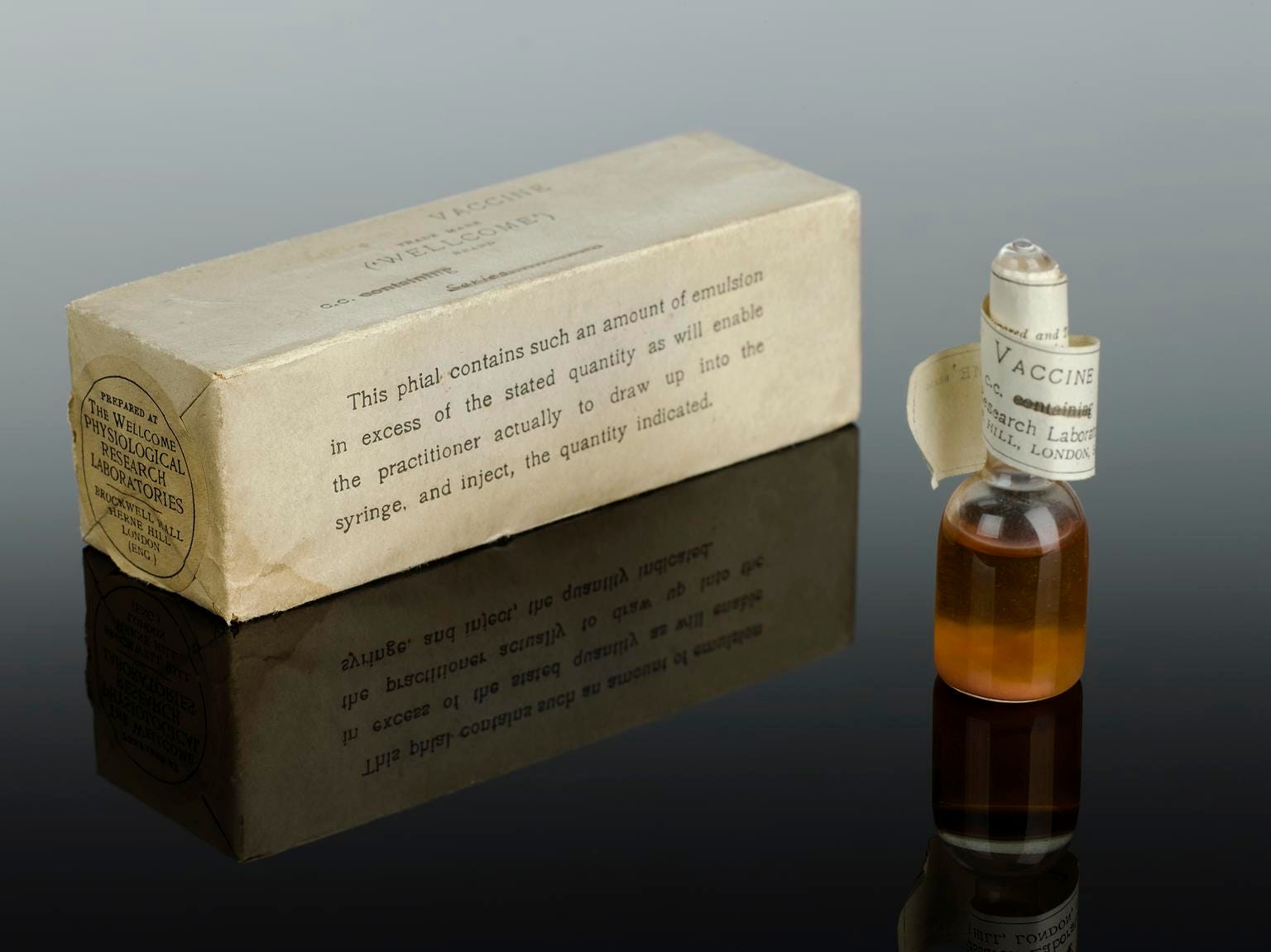
The solution was elegant. Ball separated chaulmoogra oil into its component fatty acids, then converted those acids into ethyl esters — compounds that are water-soluble, less viscous, injectable, and absorbable by the body without causing tissue damage.
The process she developed moved through four stages. First, saponification: she boiled the raw oil with potassium hydroxide to break the glycerol bonds, turning the fatty acids into a soluble potassium soap. Second, acidification: she treated the soap mixture with hydrochloric acid to precipitate out the pure, free fatty acids. Third, fractional freezing: drawing on her kava research, she precisely chilled the mixture to isolate specific fractions of the fatty acids. Fourth, esterification: she reacted the isolated fatty acids with ethyl alcohol and dry hydrogen chloride gas, chemically substituting the heavy molecular components with a light ethyl group.
The resulting ethyl esters retained the exact medicinal, bacteria-destroying properties of the original chaulmoogra oil but possessed a completely transformed physical state. They were thin. They were mobile. They were soluble in water. They could be injected into the bloodstream without causing abscesses or tissue damage. They could be absorbed by the body and actually used.
The Ball Method worked. Patients who had been exiled, who had been told they would never go home, began recovering. At the Kalihi Hospital in Honolulu, seventy-eight patients recovered sufficiently to return to their families. Across the Pacific, in leprosy settlements where people had been legally erased from their own lives, the Ball Method became the standard treatment.
Alice Ball did not live to see any of it.
With the nation preparing for war and universities across the country running civil defense training, Alice Ball was teaching a laboratory demonstration on gas mask use in September 1916 when she was exposed to chlorine gas. Her ventilation was inadequate. She became gravely ill, took a leave of absence, and returned to Seattle.
She died on December 31, 1916. She was twenty-four years old.
Her death certificate lists the cause as tuberculosis. A 1917 newspaper article in the Pacific Commercial Advertiser reported chlorine poisoning from the laboratory accident. The College of Hawaii denied that account. The peer-reviewed Journal of Chemical Education, reviewing the historical record in 2024, concluded that the cause of her death may have been deliberately concealed.
She died before she could publish her findings. And before anyone could stop him, Arthur L. Dean moved in.
Dean was the chairman of the Chemistry Department at the College of Hawaii, Alice Ball’s direct superior. After her death, he continued her research, made slight modifications, and published. In 1920, Dean and his co-author Richard Wrenshall published a paper on the fractionation of chaulmoogra oil in the Journal of the American Chemical Society. Alice Ball’s name does not appear. In 1920, Dean co-authored a second paper on the treatment of leprosy with chaulmoogra derivatives. Alice Ball’s name does not appear. In 1922, Dean and Wrenshall published a third paper on the preparation of chaulmoogra oil derivatives for the treatment of leprosy. Alice Ball’s name does not appear.
Three papers. Three publications. Not one mention of the woman whose work they were built on.
Dean named the process the Dean Method. He distributed the injectable chaulmoogra treatment to leprosy clinics worldwide with his name on it. The injectable treatment traveling to the most remote, under-resourced clinics in the world carried his name and not hers.
What saved Alice Ball from complete erasure was a colleague who was angry enough to do something about it.
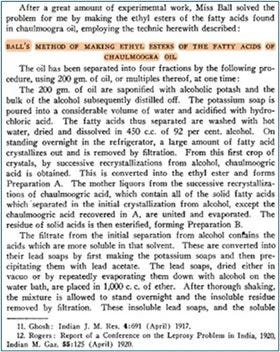
In 1922, the same year Dean published his third paper on her work, Harry T. Hollmann published his own paper in the Archives of Dermatology and Syphilology. He titled it “The Fatty Acids of Chaulmoogra Oil in the Treatment of Leprosy and Other Diseases.”
He named her.
He described her work in detail. He called the process the Ball Method. And then he went further. Hollmann didn’t just restore her name — he used a peer-reviewed scientific paper to methodically dismantle Dean’s claim that his modifications represented an improvement. He wrote:
“In 1915, at my suggestion, Miss Alice Ball, M.S., an instructor in chemistry at the College of Hawaii, took up the chemical problem of isolating the active principles of chaulmoogra oil... After a great amount of experimental work, Miss Ball solved the problem... She prepared the ethyl esters of the fatty acids of chaulmoogra oil.”
And then, on Dean:
“I can see no change in the method described by Dean from that which was worked out by Miss Ball, except that he describes the use of a vacuum distillation in the transfer of the esters... which in my opinion is a step backward, making the product more expensive and less available for the average practitioner.”
A step backward.
Read that again. Dean’s version wasn’t just redundant. It was worse. More expensive. More complicated. Harder to replicate. It required equipment that most leprosy clinics in the world — the remote ones, the under-resourced ones, the ones serving the patients who needed this treatment most, simply didn’t have.
Alice Ball’s original method could be done anywhere, by any physician, with modest equipment and careful study. That was the point. That was the genius of it. She hadn’t just solved the chemistry. She had solved it in a way that could reach the people who were dying. And Dean’s unnecessary complications had made it less accessible to the very patients it was designed to save.
Hollmann said so. In print. In a peer-reviewed journal. Under his own name.
It is the most thorough academic takedown you can perform without raising your voice.
Even with Hollmann’s intervention, it was not enough.
Alice Ball’s story disappeared for decades. The reasons are not mysterious. She was a Black woman who had worked without pay, without a dedicated lab, without institutional protection, in a field dominated by men who held the positions, the publications, and the platforms. She died at twenty-four before she could establish the paper trail that might have anchored her name to her own discovery. The man who took her work held institutional power and used it. The First World War, Jim Crow, and the general machinery of erasure did the rest.
It wasn’t until the 1970s that researchers began seriously investigating her contributions. It wasn’t until 2000 that the University of Hawaii formally acknowledged her as the inventor of the Ball Method, issuing a proclamation and placing a commemorative plaque near the chaulmoogra tree on the Manoa campus, planted in 1935, in honor of the research, with no name attached. The institution had loved the achievement for sixty-five years without mentioning the person responsible for it. In 2007, the university awarded her a posthumous Medal of Distinction. Alice Ball Day is now observed every February 28th in Hawaii.
Her original thesis, The Chemical Constituents of Piper Methysticum, submitted to the College of Hawaii in June 1915, is now publicly available through Project Gutenberg and preserved in the University of Hawaii’s digital archives. You can read it. Her name is on every line of work.
What Alice Ball did was not a lucky accident or an inspired guess. It was the result of a childhood spent in the chemistry of darkrooms, two undergraduate degrees completed before most of her peers had started one, a master’s thesis that solved a problem other scientists had failed to crack, and months of painstaking bench work done on her own time, without recognition or additional pay, for patients she would never meet.
She figured out how to give medicine back to people who had been pronounced legally dead.
And then she died at twenty-four, and a man put his name on her work, and the world moved on.
The Ball Method continued to be used for nearly thirty years, until sulfone antibiotics arrived in the 1940s and finally replaced it. For all those years, her process was in clinics across the world. Her chemistry was in the injections. Her name was not.
It is now.
Sources
Ball, Alice A. The Chemical Constituents of Piper Methysticum. Master’s thesis, College of Hawaii, June 1915. Available via Project Gutenberg (ebook #67736) and the University of Hawaii at Manoa digital archives.
Dehn, W.M., and Alice A. Ball. “Benzoylations in Ether Solution.” Journal of the American Chemical Society, vol. 36, no. 10, 1914, pp. 2091–2101.
Hollmann, Harry T. “The Fatty Acids of Chaulmoogra Oil in the Treatment of Leprosy and Other Diseases.” Archives of Dermatology and Syphilology, vol. 5, no. 1, January 1922, pp. 94–101.
Dean, Arthur L., and R. Wrenshall. “Fractionation of Chaulmoogra Oil.” Journal of the American Chemical Society, vol. 42, no. 12, 1920, pp. 2626–2645.
Dean, Arthur L., and R. Wrenshall. “Preparation of Chaulmoogra Oil Derivatives for the Treatment of Leprosy.” Public Health Reports, vol. 37, no. 23, 1922, pp. 1395–1399.
Gomes, Stephanie Silva Weigel, and Wilmo Ernesto Francisco Junior. “Alice Ball: An African-American Woman to Foster Education in Chemistry.” Journal of Chemical Education, vol. 101, no. 12, November 2024, pp. 5231–5239. https://doi.org/10.1021/acs.jchemed.4c00611
Wermager, P. “Healing the Sick.” Social Process in Hawaiʻi, vol. 43, 2004, pp. 162–188.
Wermager, P., and C. Heltzel. “Alice A. Augusta Ball: Young Chemist Gave Hope to Millions.” ChemMatters, vol. 25, no. 1, 2007, pp. 16–19.
National Women’s History Museum. “Alice Ball.” womenshistory.org/education-resources/biographies/alice-ball
Chitson, Rebekah. “Happy Alice Ball Day!” Science Museum Blog, February 28, 2024. blog.sciencemuseum.org.uk/happy-alice-ball-day
Lambert, M.M. “A Young Black Scientist Discovered a Pivotal Leprosy Treatment in the 1920s — But an Older Colleague Took the Credit.” The Conversation, March 20, 2024.
HistoryLink.org. “Ball, Alice Augusta (1892–1916).” historylink.org/File/23522
African American Registry. “Alice Ball, Chemist and Researcher Born.” aaregistry.org
London School of Hygiene & Tropical Medicine. “Alice Augusta Ball.” lshtm.ac.uk/aboutus/introducing/history/behind-frieze/alice-augusta-ball